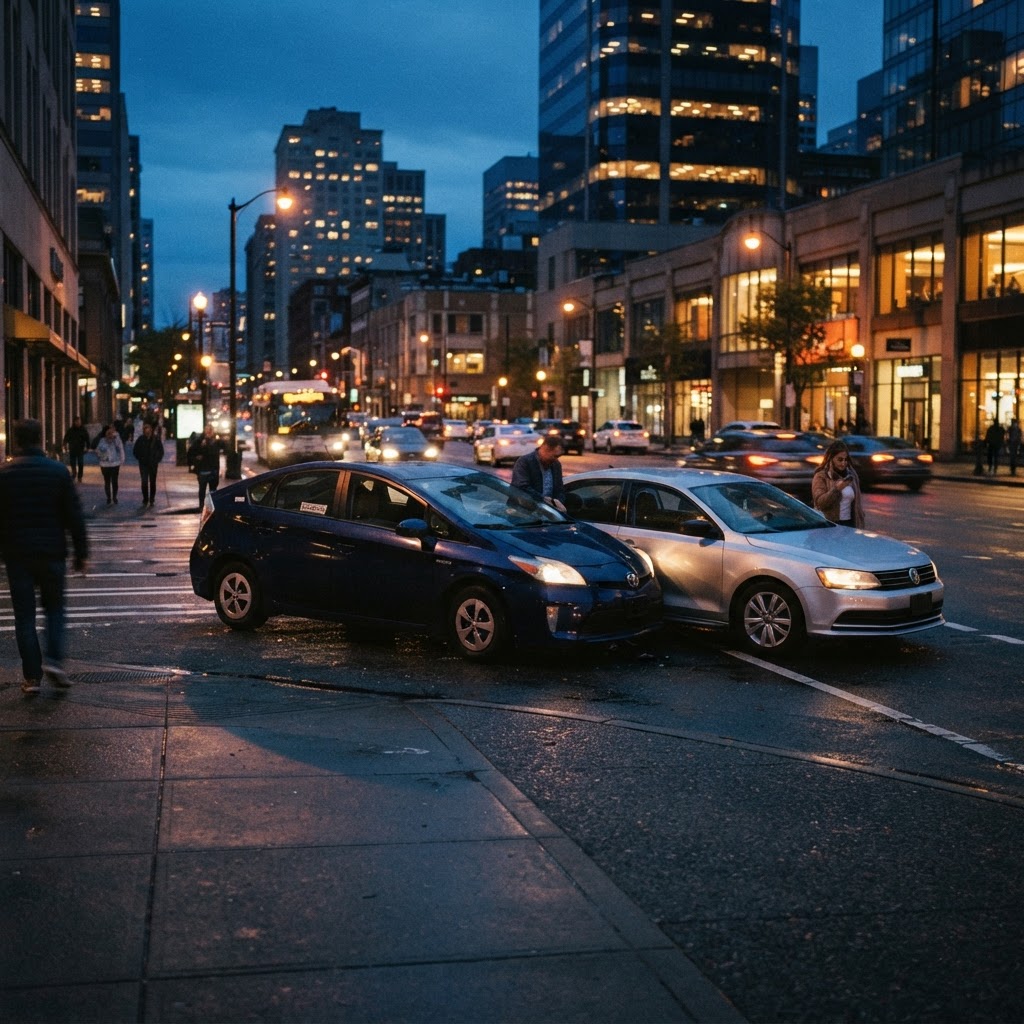
If you are hit by an Uber in California, you may be able to sue the Uber driver, Uber itself, another motorist who caused the crash, a commercial employer whose driver was involved, a vehicle or parts manufacturer, or a government agency responsible for a dangerous road. Which of them is responsible, and which insurance policy pays, depends on how the crash happened and what the Uber driver was doing on the app at the moment of impact.
Why Uber Crash Claims Are More Complicated
An ordinary fender bender on the 101 usually involves two drivers and two insurance cards. Rideshare crashes bring in a large corporation, independent contractor rules and insurance coverage that changes depending on the driver's app status. For a broader look at these challenges, see what makes rideshare accident cases so complex.
The single most important fact is what the driver was doing on the app when the crash happened:
- Logged out entirely?
- Logged in and waiting for a ride request?
- On the way to pick someone up?
- Carrying a passenger?
Each answer triggers a different insurance policy and sometimes a different defendant. Get the timeline wrong, or let an adjuster gloss over it, and you could end up pursuing the wrong source of payment.
Defendant 1: The Uber Driver
The most obvious defendant is the driver. A claim against a rideshare driver for careless driving works like a claim against any other motorist. Common examples include speeding down Sunset to reach the next fare, running a red light near the arena on a game night, drifting between lanes while looking at the app, or tailgating on the 405.
The legal theory is ordinary negligence: the driver owed you a duty to drive safely, breached it and caused your injuries. The driver's app status does not change that theory, but it does decide which insurance policy responds.
Defendant 2: Uber Technologies Inc.
Suing Uber itself is a different and harder path, and it is where most of the confusion in these cases comes from.
Why Uber Is Not Automatically Liable
When an employee causes a crash on the job, such as a company van driver on a delivery run, the employer is usually responsible under a doctrine called vicarious liability. Uber drivers are not employees. California's Proposition 22 established app-based drivers as independent contractors, so Uber does not automatically answer for a driver's mistakes the way a traditional employer would.
Insurers sometimes lean on this to suggest that an unrepresented victim has no claim involving Uber at all. That is not accurate. It means the route to Uber's money runs through the required rideshare insurance and specific legal theories, not automatic employer liability.
How Coverage Changes With App Status
California law, originally enacted as Assembly Bill 2293 and now part of the Public Utilities Code, requires Uber and Lyft to carry different coverage depending on the driver's status at the moment of impact. A few seconds of app data can move available coverage from a limited policy to a $1 million commercial policy, which is why this timeline is often the most contested part of a rideshare claim.
| Driver app status | Coverage available |
|---|---|
| Offline (not logged in) | Driver's personal auto policy only; Uber's commercial coverage does not apply |
| Logged in, waiting for a request | $50,000 per person / $100,000 per accident for bodily injury, and $30,000 property damage |
| Ride accepted, en route to pickup | Up to $1 million in commercial liability coverage |
| On a trip with a passenger | Up to $1 million in commercial liability coverage, plus reduced UM/UIM coverage |
The offline scenario is riskier than many people realize. Most personal auto policies exclude commercial rideshare activity, so disputes over whether the driver was truly logged out can create a serious coverage gap. Our article on Uber, commercial driver insurance and the $50,000 problem explains this in more detail.
Direct Claims for Uber's Own Negligence
The independent contractor label does not protect Uber from its own mistakes. A direct negligence claim may be possible if Uber:
- Ignored repeated safety complaints, for example keeping a driver active after multiple riders reported aggressive driving on the 110
- Failed to run proper background checks and missed a recent DUI or reckless driving conviction
- Disregarded clear warning signs, such as rider reports that a driver was nodding off on late-night airport runs
Proving these claims requires obtaining Uber's internal safety records and the driver's platform history, which usually means formal legal process. When the facts support it, it can be an important avenue for compensation.
What About Robotaxis?
Driverless services like Waymo are now a regular sight around Los Angeles, and they change the analysis. With no human behind the wheel, ordinary driver negligence does not apply in the same way. Under evolving California rules, the automated driving system is treated as the driver, which points responsibility toward the company operating the vehicle. A crash with a driverless car needs its own legal analysis, so do not assume it works like a standard Uber claim.
Uber's Arbitration Clause
Many people do not realize that accepting Uber's app terms can mean agreeing to resolve disputes with Uber in private arbitration rather than in court. Courts have enforced these clauses broadly. In one widely reported New Jersey appellate case, a couple was sent to arbitration over crash injuries even though they said it was their daughter who accepted Uber's terms while ordering food on the account.
Uber allows riders to opt out of arbitration within a limited window after creating an account or accepting updated terms, but few people do. The clause has limits, though. It mainly affects claims against Uber the company. It generally does not eliminate claims against the driver personally or your ability to recover through the applicable insurance policy. Who you sue and who actually pays are not always the same question.
Defendant 3: Another Motorist
Many Uber crashes are caused by someone else entirely. If another driver caused the collision, that driver and their insurer become the primary defendants, whether you were the Uber passenger, the Uber driver or a bystander. Think of a drunk driver running a light in Koreatown, a distracted motorist rear-ending your Uber on Wilshire, or a hit-and-run driver clipping the car near LAX. Our Central Los Angeles office sees these crashes regularly.
The trouble starts when that driver has no insurance or too little to cover serious injuries.
Senate Bill 371 and Reduced Uninsured Motorist Coverage
For years, California required Uber and Lyft to provide $1 million in uninsured and underinsured motorist coverage for passengers. Senate Bill 371, effective January 1, 2026, reduced that requirement to $60,000 per person and $300,000 per incident. Uber has pointed out that its $1 million liability policy still applies when its own driver causes a crash. That is exactly the issue: the protection for passengers hurt by someone else has shrunk dramatically.
Picture riding home from a downtown concert when an uninsured driver T-bones your Uber. A single spine surgery can exceed $60,000 before physical therapy even starts. That makes investigating every other potential defendant, and checking your own auto policy's UM/UIM coverage, more important than ever in a rideshare injury claim.
Defendant 4: A Commercial Employer
Rideshare drivers share the road with delivery vans, box trucks, semis, tour buses and utility vehicles. When a commercial driver causes a crash while working, the employer is usually responsible under traditional employer liability rules, the same rules that generally do not reach Uber. If a delivery van cuts across three lanes near LAX and hits an Uber at the curb, the delivery company can become a primary defendant, often with much deeper insurance. See our page on truck and commercial vehicle accidents.
Defendant 5: A Vehicle or Parts Manufacturer
Sometimes the cause is mechanical. Brakes that fail on a canyon road, a tire that separates while merging onto the 5, an airbag that does not deploy or a steering component that breaks can cause or worsen a crash no matter how carefully the driver was driving. When a defect is involved, a separate product liability claim may be brought against the manufacturer, apart from any claim against the driver or Uber. Preserving the vehicle is critical in these cases.
Defendant 6: A Government Agency
Sometimes the road itself is part of the problem. A tire-blowing pothole, a traffic signal malfunctioning for weeks or a missing stop sign can make the city, county or state agency responsible for the road a potential defendant. The deadline is much shorter: most California injury lawsuits must be filed within two years, but a claim against a government entity generally must be presented within six months of the crash. Missing that window usually ends the claim against the agency, so flag road hazards immediately.
What If You Were Partly at Fault?
Insurers in rideshare cases often argue that the injured person contributed to the crash, for example a pedestrian who stepped out mid-block, a cyclist who rode outside the bike lane or a driver who changed lanes without signaling. California follows pure comparative negligence. You can still recover damages even if you share some of the blame, but your compensation is reduced by your percentage of fault. A finding that you were 20% responsible reduces your recovery by 20%, not to zero. That is why the evidence of how the crash happened matters so much.
Steps to Take After an Uber Crash
- Get medical care and follow through with treatment, even if you feel mostly fine at first.
- Screenshot the ride in your app if you were a passenger, including the trip details and driver information. If you were hit by an Uber, ask the driver whether they were on a trip and photograph any rideshare decals.
- Photograph the scene, the vehicles, license plates and your injuries.
- Collect witness information and note any nearby cameras.
- Report the crash in the Uber app and to the police, but keep your description factual.
- Be careful with adjusters. You may hear from Uber's insurer, the driver's personal insurer and another driver's insurer. Avoid recorded statements until you have legal advice.
- Keep records of bills, missed work and how your injuries affect daily life.
If You Were the Uber Driver
Drivers get hurt too. If another motorist caused the crash, you can pursue that driver and their insurer like any other injured person. If the at-fault driver is uninsured or underinsured, rideshare UM/UIM coverage and your own policy may come into play, and the same app-status questions apply. Because drivers are independent contractors, they generally are not covered by traditional workers' compensation. Proposition 22 requires rideshare companies to provide occupational accident insurance, but those benefits are more limited, which makes identifying every available liability policy even more important.
The Insider View: How Rideshare Insurers Handle Claims
Rideshare insurers are handling a high volume of claims, and they scrutinize each one for coverage defenses first: Was the driver really logged in? Was the ride really accepted? Did the passenger agree to arbitration? Only then do they evaluate injuries. Our founding attorney has fought insurers for injured Californians since 2002.
Find Every Defendant in Your Uber Claim
Every Uber crash is different, and the right answer depends on the details. If you want to understand the step-by-step process, read how to file an injury claim after an Uber or Lyft accident. To have your situation reviewed, call (818) 465-5784 or request a free consultation. You pay no attorney's fee unless we recover compensation for you.