The short answer
Rear-end collisions are often presumed to be the trailing driver's fault, but insurers still dispute injury severity and causation. Under California law, the rear driver is typically negligent, yet you must still prove your damages. Seek prompt medical care, preserve dashcam and witness evidence, and consult a lawyer before accepting the insurer's first offer.
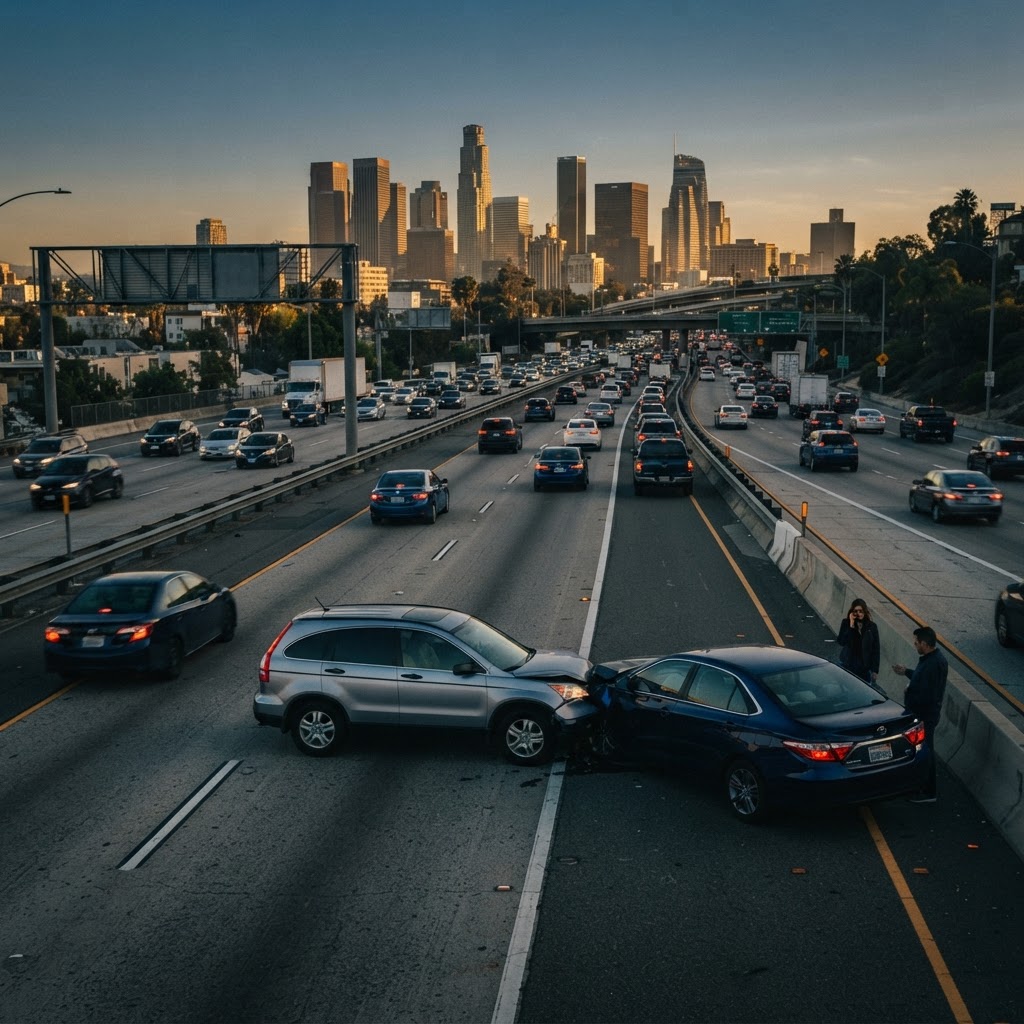
Rear-end collisions are part of daily life on Los Angeles freeways. Traffic on the 405 can go from 60 miles per hour to a dead stop in seconds, and one distracted driver is all it takes to push you into the car ahead. Because the trailing driver is usually responsible, many people assume the insurance claim will be simple. In practice, insurers rarely fight about who hit whom. They fight about how badly you were hurt and whether the crash really caused your symptoms.
That is where our background matters. Before representing injured people, our founding attorney has fought insurers for injured Californians since 2002. We watched rear-end claims get labeled as low-impact soft-tissue files and valued accordingly. We know the questions adjusters ask, the photos they pull, and the medical-record language that moves a claim into a lower category. We use that knowledge to build your claim so those shortcuts do not work.
Neck and back injuries from a rear impact can be serious and long-lasting even when the damage to your car looks modest. Symptoms like headaches, numbness in the arms, and radiating pain may take days to appear. Early medical care, consistent follow-up, and preserved evidence such as dashcam video and repair estimates can shape how your claim is valued.
Your consultation is free, and you pay no attorney's fee unless we recover compensation for you. If you were rear-ended on the 10, the 101, or on a surface street like Ventura Boulevard or La Brea, talk with us before you accept the insurer's first offer.
From the other side of the table
How the insurer's adjuster sees your rear-end claim
The 'minor impact, soft tissue' label
Many carriers route rear-end claims with modest vehicle damage into a special handling track that assumes injuries are minimal. We document the mechanism of injury, your diagnoses, and your treatment so your claim is evaluated on the medicine rather than the bumper.
Repair photos used as injury evidence
Adjusters compare repair estimates and photos to argue the collision was too gentle to cause harm. We obtain the full repair record, including hidden damage to bumper reinforcements and frames that photos often miss.
The pre-existing condition argument
If your imaging shows any degeneration, expect the insurer to blame age rather than the crash. California law lets you recover when a collision aggravates a prior condition, and we work with your doctors to explain what changed after the impact.
The sudden-stop defense
Some rear drivers claim you stopped short or cut in front of them. We look for dashcam footage, witness accounts, and vehicle data that show traffic conditions and rebut an attempt to shift blame to you.
Why it happens
Common causes
Stop-and-go freeway traffic
Accordion-style slowdowns on the 405 through the Sepulveda Pass, the 5 near downtown, and the 101 through the Cahuenga Pass create constant rear-end risk when drivers look away even briefly.
Phone use and texting
A glance at a text or map at a red light on Wilshire or Santa Monica Boulevard can cause a driver to roll into the car ahead when they think the light has changed.
Tailgating
Following too closely leaves no margin when traffic stops. It is especially common in the carpool lanes and on freeway on-ramps where drivers push to merge.
Speeding into slowed traffic
Drivers coming around a curve or over a rise, such as on the 110 through the Arroyo Seco or the 2 through Glendale, may not see stopped traffic in time.
Impaired or fatigued driving
Drowsy drivers and those under the influence often fail to brake at all, producing high-speed rear impacts with serious injuries.
Chain-reaction collisions
In multi-car pileups, a single rear impact can push several vehicles together, raising questions about which driver caused which injuries.
What we see
Injuries we handle
What you may recover
Compensation in a California claim
Current and future medical care
Doctor visits, imaging such as MRIs, physical therapy, injections, and surgery if needed, along with treatment your physicians expect you to need later.
Lost income
Wages, commissions, and self-employment earnings lost while you recovered or attended appointments, plus reduced earning capacity if your injuries limit your work long term.
Pain, suffering, and emotional distress
The physical pain, stiffness, sleep problems, anxiety about driving, and loss of enjoyment of daily activities that follow a rear-end injury.
Aggravation of a prior condition
If you had an old back or neck problem that the crash made worse, you may recover for the added harm, even if the insurer argues your condition was pre-existing.
Vehicle repair and related costs
Repairs or replacement, a rental vehicle, towing, and in some cases the reduced market value of your repaired car.
The rules that apply
California law you should know
Following too closely is prohibited
California drivers may not follow another vehicle more closely than is reasonable and prudent, considering speed, traffic, and road conditions. A violation can be evidence of negligence.
Vehicle Code § 21703
The basic speed law
Drivers must never go faster than is safe for conditions, even if they are under the posted limit. Speeding into slowed traffic can violate this rule.
Vehicle Code § 22350
Duty of ordinary care
Every driver owes others a duty of reasonable care and is responsible for harm caused by a failure to use it.
Civil Code § 1714
Two-year filing deadline
A lawsuit for injuries from a rear-end collision generally must be filed within two years of the crash.
Code of Civil Procedure § 335.1
General information, not legal advice. Deadlines and rules depend on the facts of your case, so talk to an attorney promptly.
Right now
Protect your claim
Evidence to gather
- Photos of both vehicles, including close-ups of bumpers, trunk, and tow hitch
- The complete repair estimate and final repair invoice
- Dashcam footage from your car or the car behind
- Names and contact information of witnesses and other drivers in a chain collision
- The police or CHP report number
- Medical records from your first visit forward, including imaging reports
- Records of any prior treatment to the same body area, to show what changed
- A symptom journal noting headaches, stiffness, and activities you could not do
Mistakes insurers count on
- Telling the adjuster you are 'fine' or 'just sore' before you have been examined
- Letting the car be repaired before photographing all damage
- Stopping physical therapy early because appointments are inconvenient
- Hiding a prior neck or back problem instead of addressing it directly
- Accepting a quick offer based only on your emergency room bill
Step by step
How we handle your case
- 1
Listen and assess
In a free consultation we review the crash, your symptoms, and any correspondence from insurers, then explain how a rear-end claim typically unfolds.
- 2
Lock down liability early
We obtain the police report, request dashcam and nearby business video, and collect witness contacts so the rear driver cannot later rewrite what happened.
- 3
Document the injury mechanism
We gather complete repair records and medical documentation that connect the force of the impact to your specific injuries.
- 4
Support your treatment record
We help you understand why consistent care matters, and we coordinate records so your chart accurately reflects your symptoms and progress.
- 5
Negotiate from the insurer's own framework
We present a demand organized around the factors adjusters actually weigh, and we are prepared to file suit if the carrier refuses to evaluate your claim fairly.
From the Case Vault
Related results
Past results do not guarantee a similar outcome. Every case is different and must be evaluated on its own facts.
Straight answers
Frequently asked questions
Usually, but not always. The trailing driver has a duty to keep a safe distance and speed, and a rear-end impact is strong evidence that they did not. The rear driver may argue that you stopped suddenly without reason, that your brake lights were out, or that another car pushed them into you. We investigate those possibilities early so that any attempt to shift blame is met with evidence.
Vehicle Accidents